Archive Page 10

Lego Clone Army – AT-PT

Continuing on with my clone army next up is my version of an AT-PT . I basically needed a small light walker, all the existing Lego sets are quiet big, bulky and tall at least for wargamming. Due to line of sight rules in most games and the bulkiness of lego I try to keep my models thinned down so I suffer as smaller a disadvantage as possible when playing against a regular lead/pewter/paper army. After checking through Wookepedia under AT’s it seemed the AT-PT would fit the bill nicely. Not wanting to reinvent the wheel I had a look around at what other Lego AT-PT’s had been created. Saber-Scorpion had created  a rather nice AT-PT and after looking at the pictures of his design and comparing it to the wookepedia article I designed my own AT-PT, incorporating some elements from saber’s design and some of my own:

Saber uses a large lift able square lid part which seems to be ultra-rare not something you want when you need 3-4 of the unit for wargamming. Neither of my two designs allow the lego minifig to be removed either way it’s trapped in there:

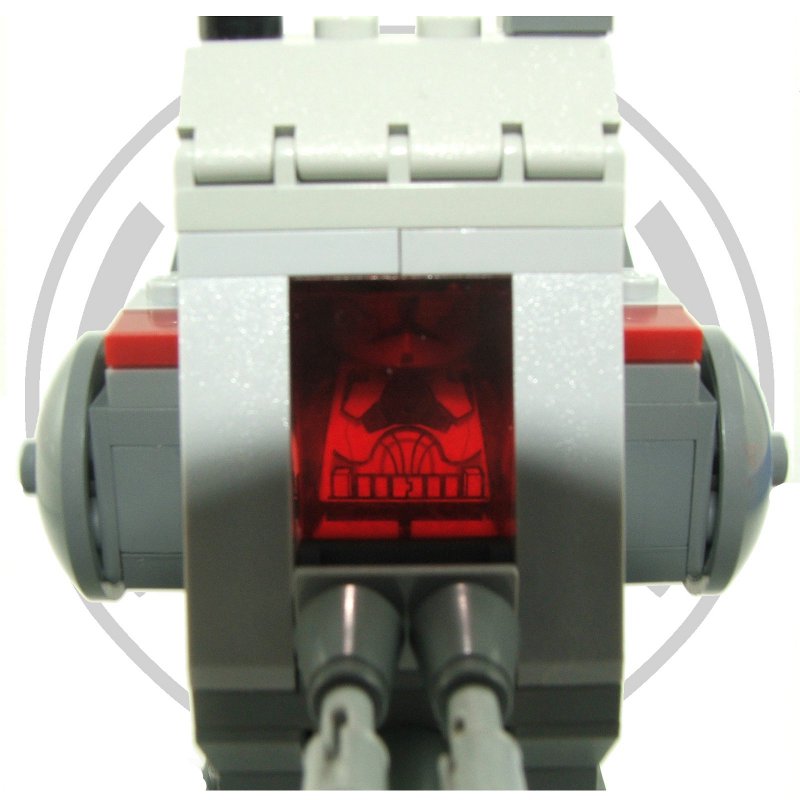
The first design (detailed in the instructions below) makes use of only very standard and common parts and should be fairly cheap to build up from a stockpile of bricks and order anything missing from ebay/bricklink very cheaply . The second design (The ones in my photo) make use of a flip lid (part no 4857) although not expensive it can be difficult to track down and only comes in light grey  not the new light bluish grey (see photos for colour difference), you also need a few tiles so it doesn’t seal closed :). Other than that minor difference the two designs are identical. You can fit a clone trooper into both with a helmet on although the arms do need to be place down by his sides. However it looks good when you look through the windshield to see a minifig in there:

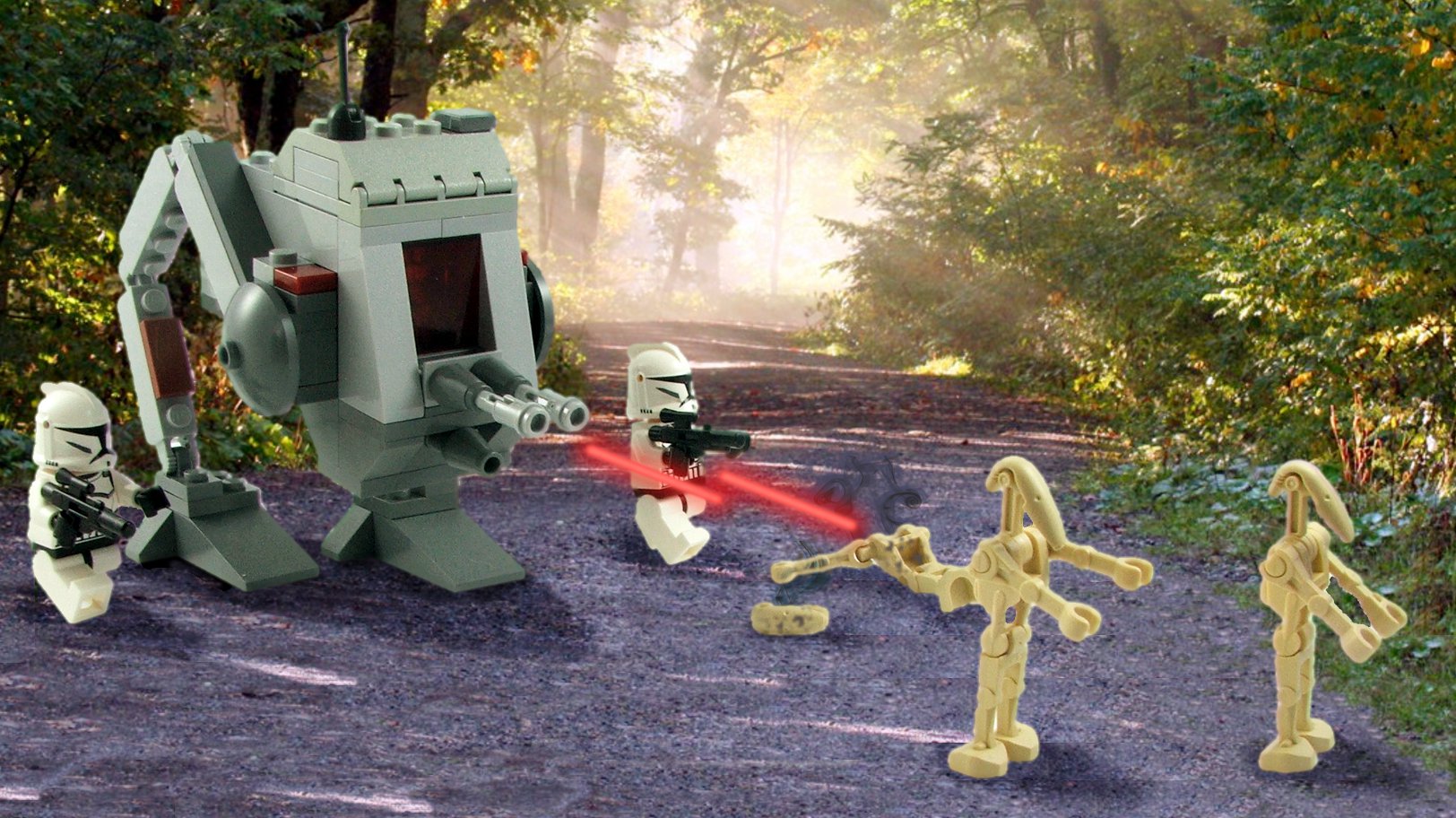
I had enough parts to build 3 and I’m a few bits short for a 4th. At this stage they all have different coloured windshields I wanted all red ones but that part in red seems to be another rarity so I have a blue trans and grey trans version. When gaming I just stick a different colored tile to the top to help id each one. As with the Speeder Bikes I did an action shot in GIMP:

I assembled the instructions using Ldraw/Mlcad and a set of PDF instructions are below, I didn’t quiet get the legs at the correct angle but they are very close:

Instructions Lego Star Wars AT-PT

Got to get back to cleaning up the house :).

Lego Clone Army – Combat Speederbikes

Since last year I have been working on a star wars lego clone army for use during wargamming.  I always planned for this to be a long term project due to the costs involved, basically you don’t save any money by assembling an army in lego but it does let me combine two of the hobbies I enjoy. The clone army is now getting close to completion so I’ll start some posts on this little side project, Starting of with the speeder bikes.

So I purchased two packs of set 7655 from bricklink they came with no lego minifigs which suited me and were hence very very cheap. I disliked the stock lego design:


However I had some ideas on how to combine all the parts from the set plus a few additions into something more interesting. I wanted a more heavy looking build to indicate the speeders are designed less for scouting and reconnaissance and more for a support/anti-infantry role during a frontal assault battle. The speeders would also be a single seater but appear to be highly maneuverable. After a few hours playing around with bricks and build combinations I settled on the below to fill the role as Combat speederbike.

As it turned out I didn’t have enough of the correct colors to completely outfit two in the correct colours but did have enough bricks to at least have two I could use during gaming. Next time I order up some bricks I’ll get some correct coloured bricks/tiles. The flags are used during gaming for tracking which unit is which:

from the pictures you can see the minifig has some protection along the side rear and front, although I’m not sure id want to ride one into battle it’s  a significant improvement over the stock lego version.  I played around in GIMP for 5mins a pulled the below together, racing across the deserts of Tatooine into battle or possibly some other desert world:

In case I lose the above or someone wants more detailed assembly instructions, I’ve put some quick instructions together on how to assemble:

Instructions Combat Speeder

I have been working on the last few troop types of my fox army as well so I’ll be posting an update to those hopefully in the next few weeks as well as some more lego stuff, well back to the projects for me 🙂

Spore – Galactic Adventures – Crystal Conundrum

While my wife was unwell I played some Spore and picked up the two expansion packs Creepy and Cute and Galactic Adventures (both went on sale for half price). Once you get a stable install running, by that I mean one that only crashes a few times a week the game isn’t to bad to play. The strongest point of the game is the ability to use the predefined library of shapes and textures to create unique creatures, buildings and vehicles. The Galactic Adventures (GA) expansion pack adds the ability to put together rather simple first person adventures and I was assembling an adventure in GA for Annette to play while sick but she recovered before I finished.  I did sink a  significant amount of time into developing the adventure so thought it deserved it’s own blog post.

I started off scratching out a storyline and then splitting it across the 8 available acts in the game.  Initially I thought I had 9 acts so the adventure  gets a little rushed/compressed in the end 3 acts but at that stage I didn’t want to re-do big chunks of dialogue. The basic story line is that the inhabitants of the planet are all plant based and that they terraformed and setup this planet for themselves to live on several 100 years ago. Then another race comes a long and they wish to dig up some purple spice crystals (Spores main game focus is  on spice gas so I threw in crystals for a difference)) as they are ultra rare and valuable. In the process the miners are displacing the plant peoples and destroying there world. I can see when I thought up the storyline sub consciously I’ve been affected by Avatar…but anyway.

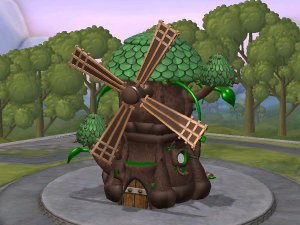
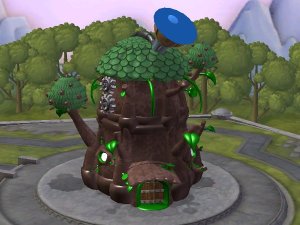
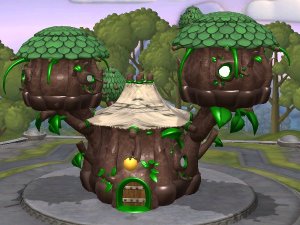
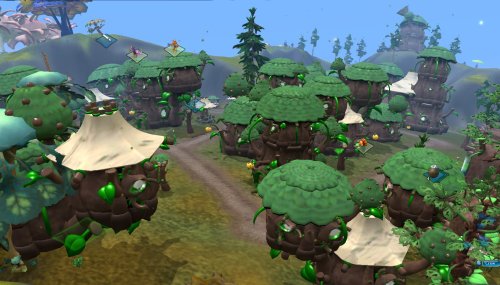
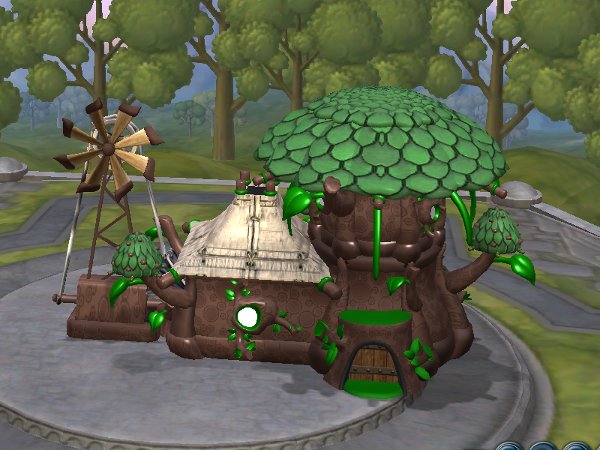
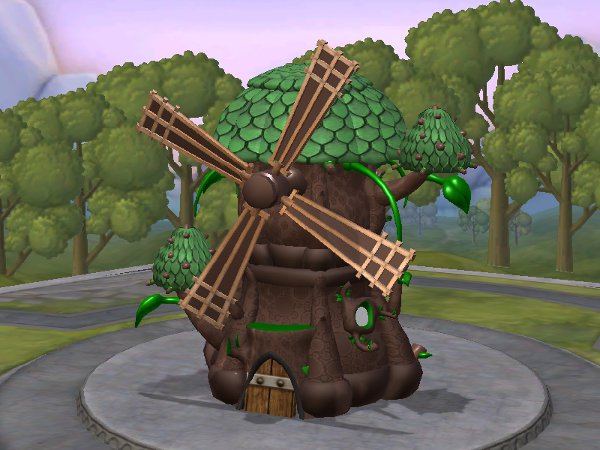
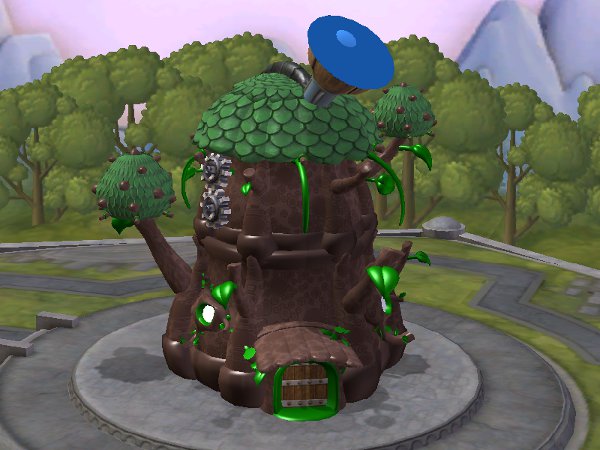
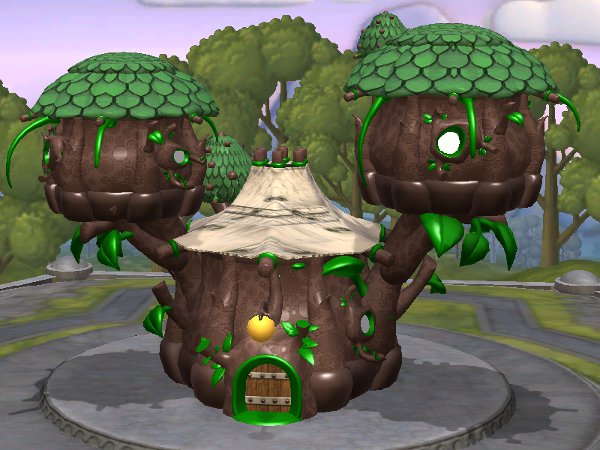
That’s a brief overview, first up I designed the plant city and it’s buildings. I wanted these to look like tree’s as if they had been grown to the required shape. I checked through the Sporepedia and couldn’t find anything suitable so designed up some of my own using existing designs in the Sporepedia as inspiration. I ended up with 5 different market stalls, Well, Street lamp, Two Different Houses, City hall, Windmill, Bakery, Building with a fence, Observatory, City Wall and Gate and an Open Air religious circle.  Below are a few images of some of the city elements:
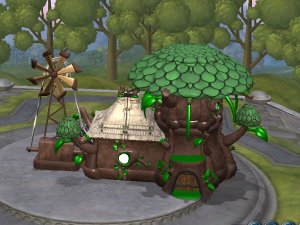
Bakery

Windmill

Observatory

House Type One

Putting it all Together

Next up came the plant inhabitants of the planet, this was slightly more difficult as spore is configured for more your normal kind of animal rather than your living tree. But I looked around at what had been done in Sporepedia and then Built up my own people using bits from existing critters as inspiration. I ended up with quiet a few different variates of plant people: Cactus, Daisy, Mushroom, Palm and Some odd flower variates. Some of these I used for specific main characters and others were just to provide populace variety. Few more pictures:

Ancient Palm – Who employed you and your main contact

Captain Cutter and One of the Daisy Cutters (right) – Charged with defense of the Tree City
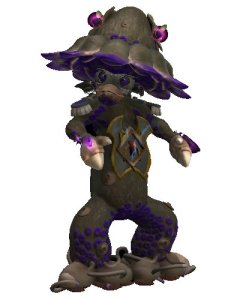
Srgt Fustugal – Looks after the Fungal Scouts

Wiley Weed– Lets just say he causes you quiet a few problems :). He’s my favorite character and design of the lot.

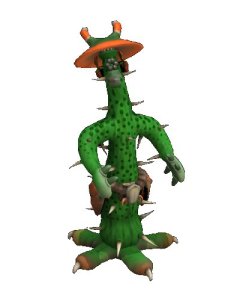

One of The flowers, Cactus Trader and a Daffodil

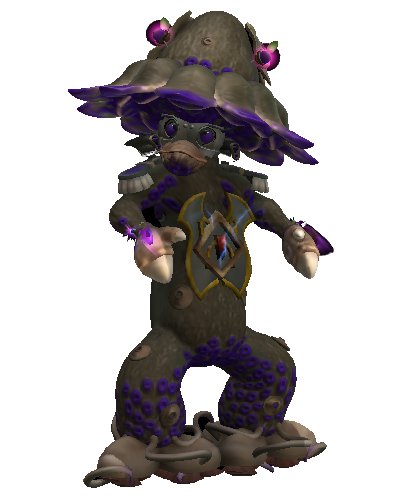
Now I moved onto the antagonists. I didn’t want your usual bad guy looking critters, more a difference on fundamental cultural level. So I designed up a totally weird looking race to play the miners. I also did a suited version to represent a heavily injured miner.   I was very happy with how they turned out:

Standard miner

Injured Miner in Support Suit

Jartooth – Old retired miner he’s a considered weird by his own race because he loves plants.

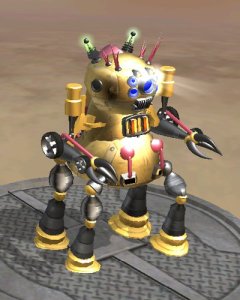
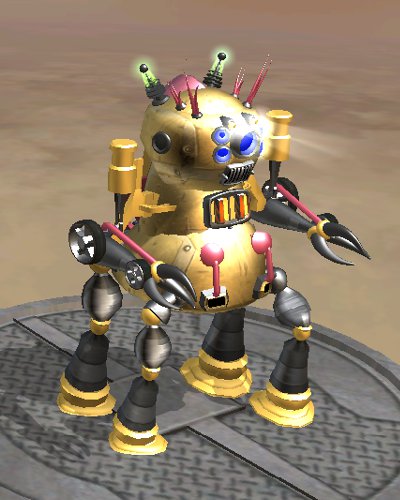
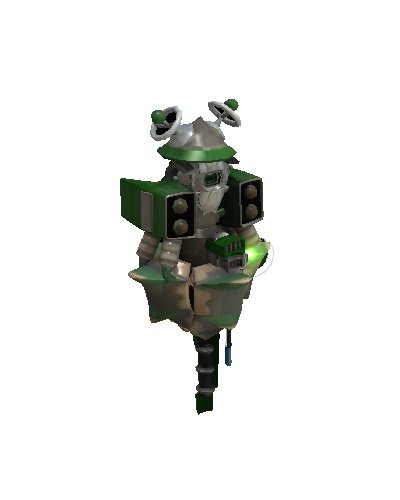
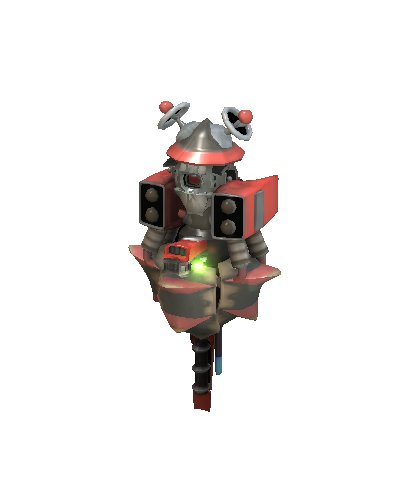
To go with the miners I also did some hi-tech robots. I ended up with two variates a defense bot who simply patrols and defends a particular location or thing  and an Attack bot who is used for offensive attacks. I was very happy with how these came out as they appear to float when they move. They are visually the same although Functionally the Defence bot is nastier than the Attack bot, This was something I needed for gameplay:
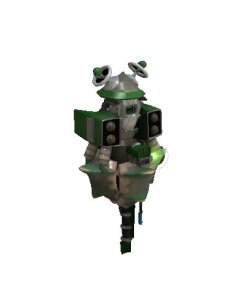
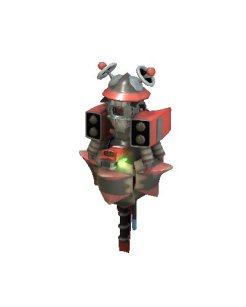
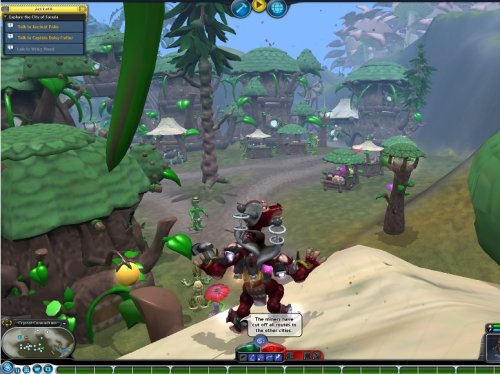
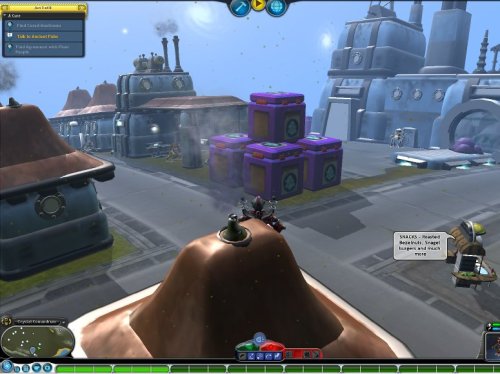
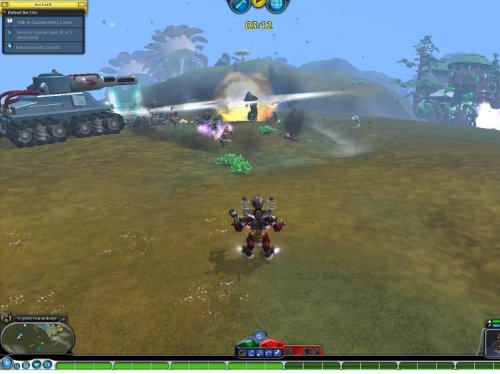
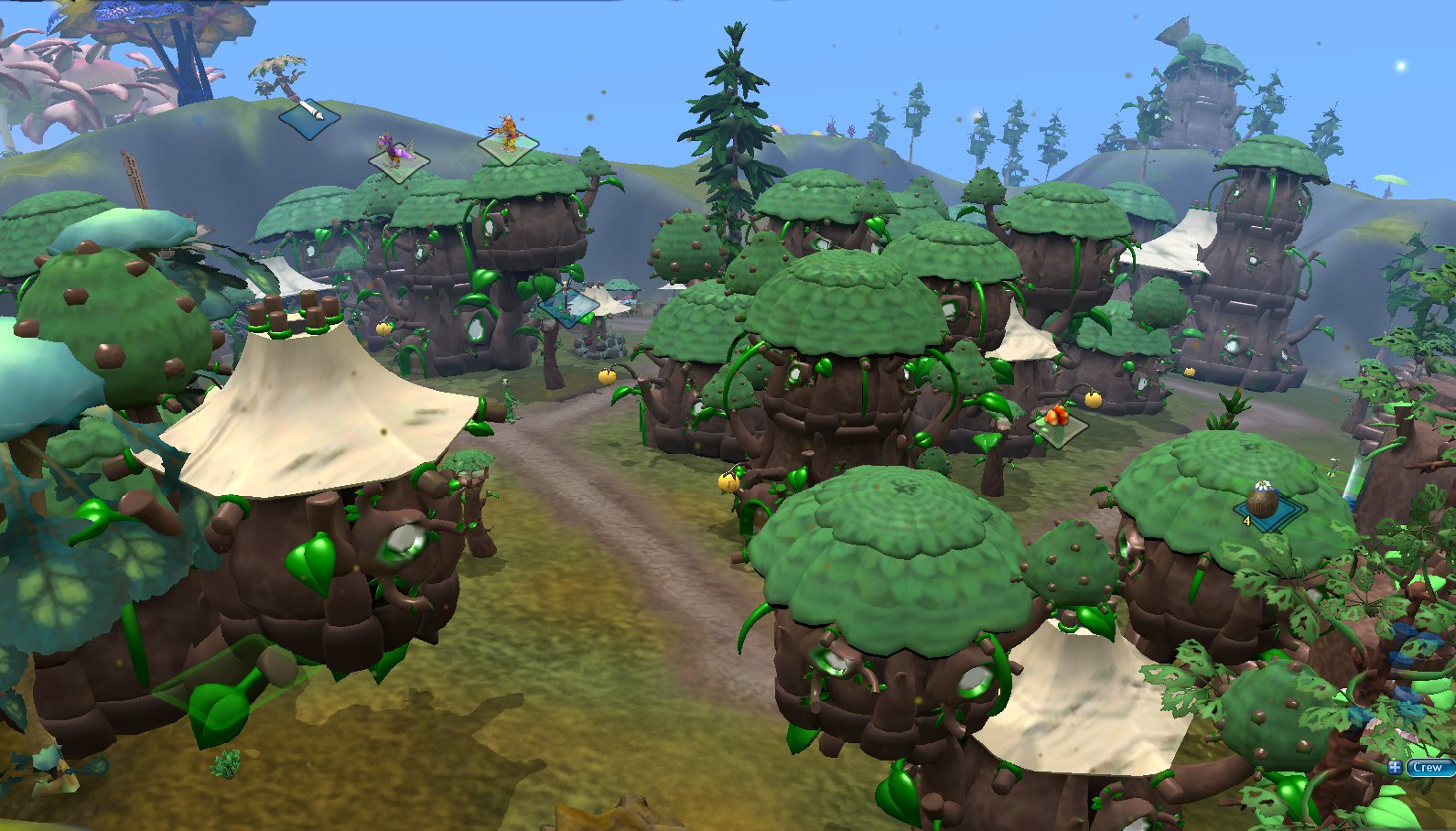
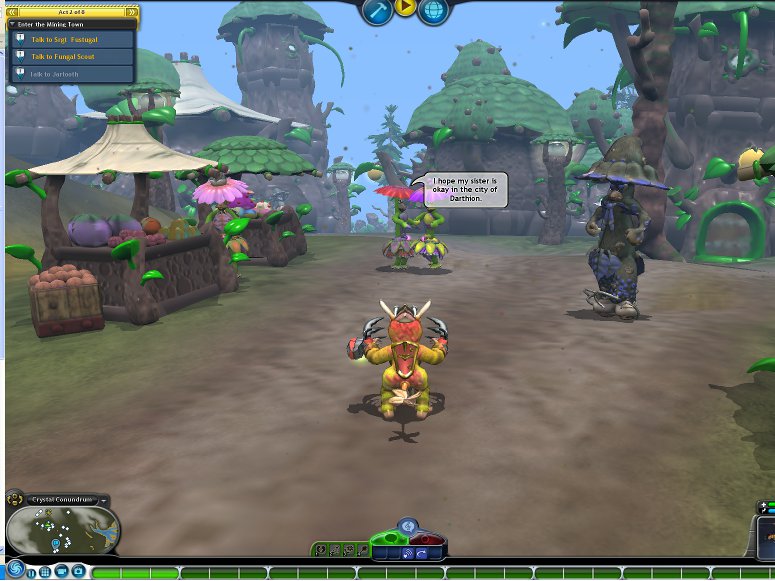
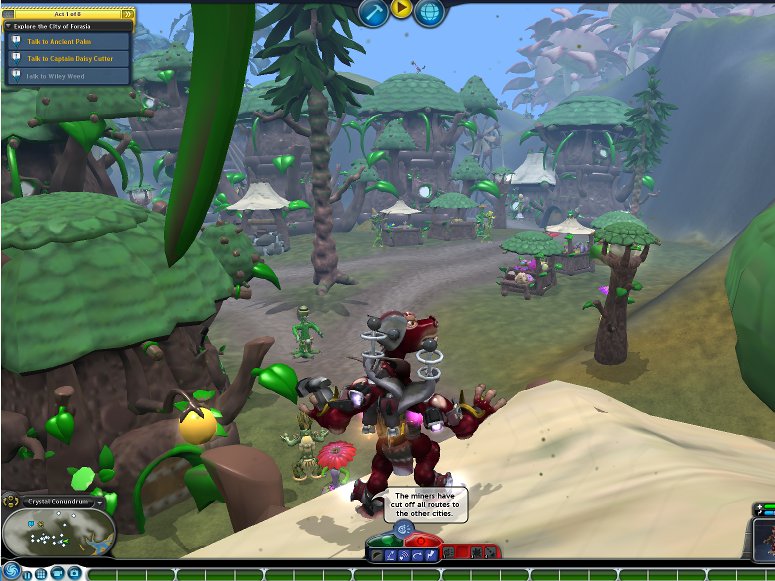
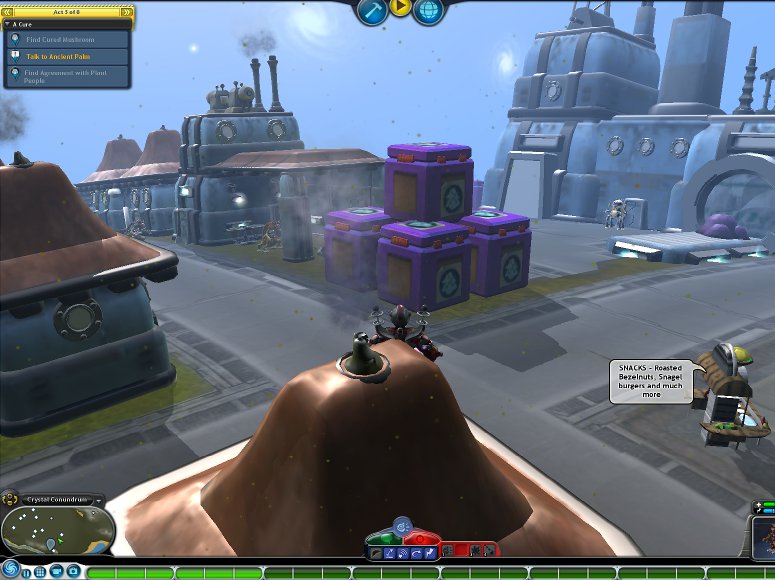
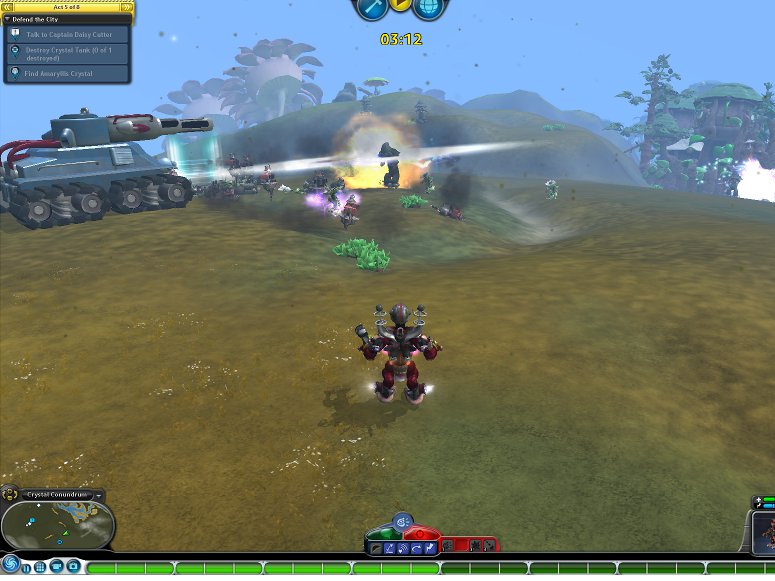
I did have to change some ideas around due to the Spore:GA engine limitations. The worst bug is the inability to place different inspect text on the same creature for different acts. Due to the complexity limit (basically a file size limit) on adventures and the work around being put a new copy of that creature in your adventure and hide the other copy you waste valuable space to work around the issue.  Saying that the functionality you do get can produce some very interesting results and my adventure reminds me of a very simplistic 1990’s console RPG with better graphics  but only takes 10-20 mins to complete.  Below are some in game screenshots:
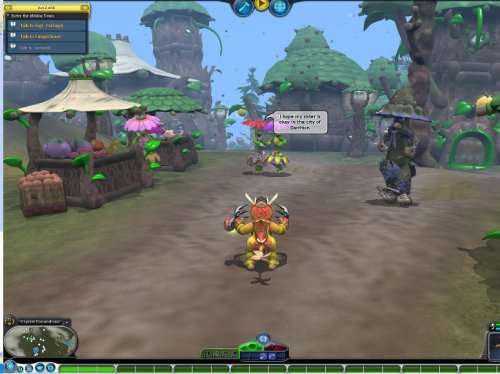
Market Square

Roof Top View

Mining Town

Battle

Link to Video

Whipped up a quick video for those who don’t play Spore

Sorry about the poor quality, for some reason spore wont take video above 320x240 even adjusting it higher under settings…

I really enjoyed putting the above adventure together although I probably took way to much time and added to much detail at least I ended up with a finished project. I’ve started back to work on my regular project stuff and I’ll be posting more on those soon.

Pumpkin and Sweet Potato Soup

Not many updates over the last month, Annette has been very unwell pretty much restricted to a bed only and in a fair amount of pain, so I’ve been focused on looking after her and going to work. I have had time to refine my pumpkin and sweet potato soup recipe  which I’ll use a fair bit over winter. It’s a very healthy soup with very little fat content and should be okay for vegetarians as well.

Ingredients (makes about 3-4 litres)

2 Butternut Pumpkins

2-4 Sweet Potatoes (500g)

4 Onions (400-450g)

8-10 Carrots (700g peeled)

2 Fresh Chillies

2-3 Garlic Cloves

4 Tablespoons Carraway Seed

4 tablespoons Cumin Seed

8 Teaspoons Vegetable Stock

6-8 Cups of water

2.5 Cups of Skim Milk

  1. Preheat Oven to 200C.
  2. Cut the top and bottoms of the Pumpkin then cut them in half lengthwise and remove the seeds. Lightly grease a baking tray and place the pumpkin halves on the tray skin side up. Place into Oven and bake for 45-60 mins.
  3. While the pumpkin is roasting peel the onions, carrot and sweet potato and roughly cut them into chunks.
  4. Cut the chills up a little finer
  5. Place 6 cups of water in a large stock/soup pot
  6. Add the Garlic, Carraway, Cumin, Chilli and Veg stock to the water
  7. Place the cut Onion, Carrot and Sweet Potato into the water and bring to the boil.
  8. Boil for 45 to 60 mins top up with water as required to keep the volume about the same and stir to ensure it dosen’t burn.
  9. Once pumpkin is roasted (skin will be brown in places). Remove from the oven and leave to cool for a short time (15-20mins) then remove the skin from the pumpkin it should peel away reasonably easily (throw the skin away).
  10. Once the Vege’s  are cooked add the pumpkin to the pot and squash/mix it in with the Vege’s, you may need to lower the heat a little to prevent the mix from burning.
  11. After 5-10mins add 2 cups of milk to the pot and mix through, leave to simmer for a further 10mins.
  12. Run the whole mix through a blender or food processor, you should end up with a smooth consistency and the seeds will break up but wont dissolve completely.
  13. Use 1/2 a cup of milk to clean the blender/food processor and add this to the pot.
  14. Leave to simmer for 15mins stirring to ensure it dosen’t burn.
  15. Serve into bowls and top with fresh cracked pepper and/or a dolp of low fat cream or plain yoghurt in the  middle of the bowl.

The above soup can be frozen but it will seperate a little when thawed but as you heat it back up stir to combine it back together. The above makes a fairly mild soup with only a hint of spice for a spicer soup add more chilli’s. If you make it I hope you enjoy it :).

Core Fox Army – Paper Miniatures

One monk runs a monthly Paper standee figure submission on his website. As I had not submitted anything for a few months I thought I’d try and complete a few standee’s for this months hoard. As it turned out onemonk also offered up a bit of a prize for his months hoard, so I ended up working up a whole core army of standee’s (Which explains why no progress on other projects this month).

I spent a few days a bit stuck for any ideas on what to do for an army I didn’t want to do the normal elf/dwarf/human fantasy armies as these are well covered already. Greywolf offered that anyone could colour his fonts available on his site for the contest. Flicking through the fonts I saw this guy and thought it would make for a nice standee:

inspiration

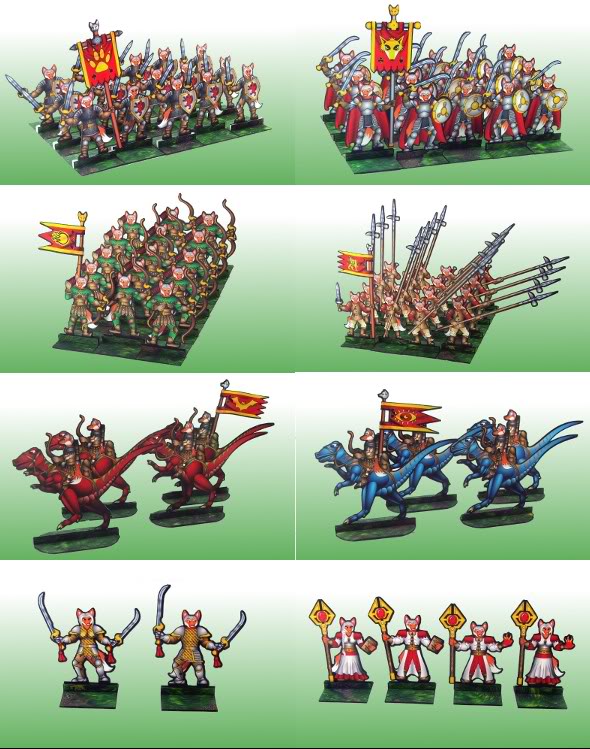
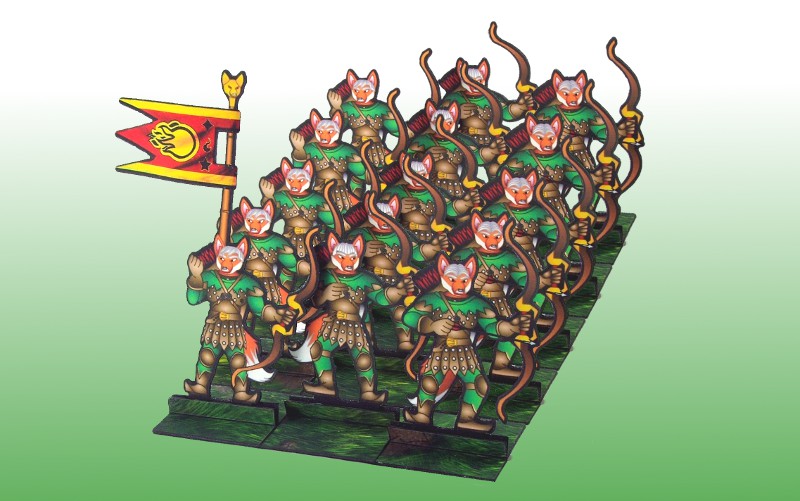
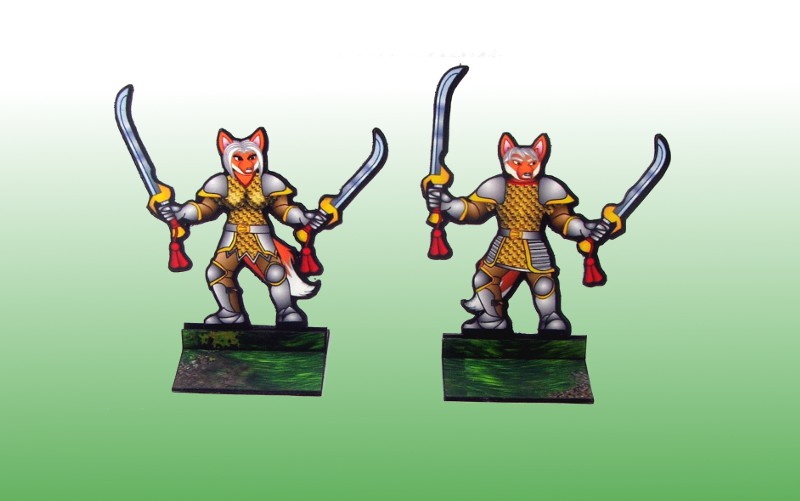
Originally I was just going to colour the above and submit it. I started work on colouring the above but wasn’t happy with the result he was to twisted sideways and didn’t look good next to other standee’s. So I decided to redraw the above using the font image above as inspiration. After a bit of work I ended up with the below as a range of figures. I did 3 different hair types to add a bit of variety:

Once I’d finished the above the ideas for different unit types, fell into my head, archers, cavalry on dinosaurs, mages, clerics, etc. I decided to match the troop types up to the HOTT core troop types list, discarding the troop types that didn’t fit in with how I visualized the army:
Paper Fox Army Troop Types

Type Description Fox Resolved
Aerial Heroes Heroes who can fly, or have a flying mount Fox on Teradactyl
Airboats Large flying platforms, like zeppelins N/A
Artillery Powerful, long ranged missile weapons Dino ballista
Beasts Savage creatures, like wolves N/A
Behemoths Elephants, Giants, Dinosaurs, etc. Archers on Brachiosaurus
Blades Well equipped foot soldiers, like the Roman legion Heavy Sword Infantry
Clerics Religious leaders who perform an anti-Magician role Fox Cleric/Monk
Dragons Large, super-intelligent flying creatures N/A
Fliers Giant Eagles or other dangerous flying creatures N/A
Gods Powerful supernatural entities, like Zeus N/A
Heroes Mighty warriors of renown Fox Hero’s
Hordes Endless seas of poorly trained and equipped fighters. Light Sword Infantry
Knights Armored horsemen who charge ferociously into mêlée Heavy Cavalry
Lurkers Creatures that hide in dark places. Water lurkers are a specialised version that live in aquatic terrain. N/A
Magicians Spell casters, sorcerers and conjurers Fox Mage
Paladins Warriors of Great Virtue Fox Paladin
Riders Mounted soldiers who fight with missile weapons in preference to mêlée Light Cavalry
Shooters Soldiers who fight with missile weapons, such as archers and crossbow men Bowman
Sneakers Ninjas and other sneaky assassin types Fox Scouts
Spears Well ordered soldiers fighting in phalanx Fox Spears
Warband Ferocious soldiers who lack discipline but not bravery Possible Wild Fox’s?

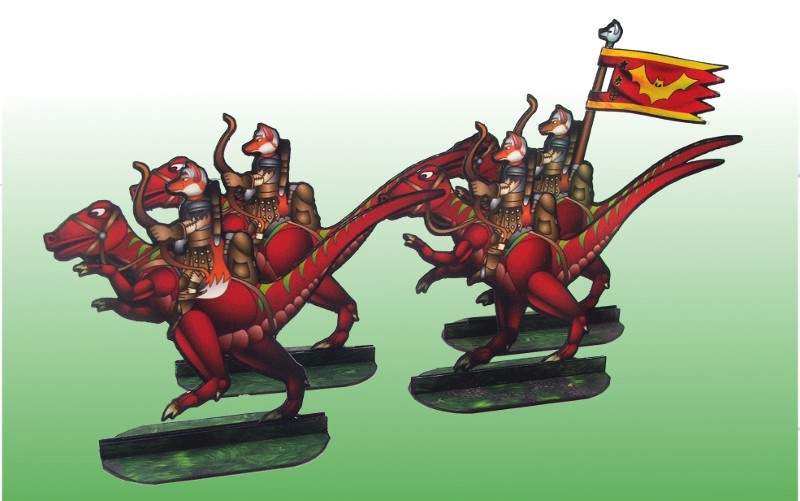
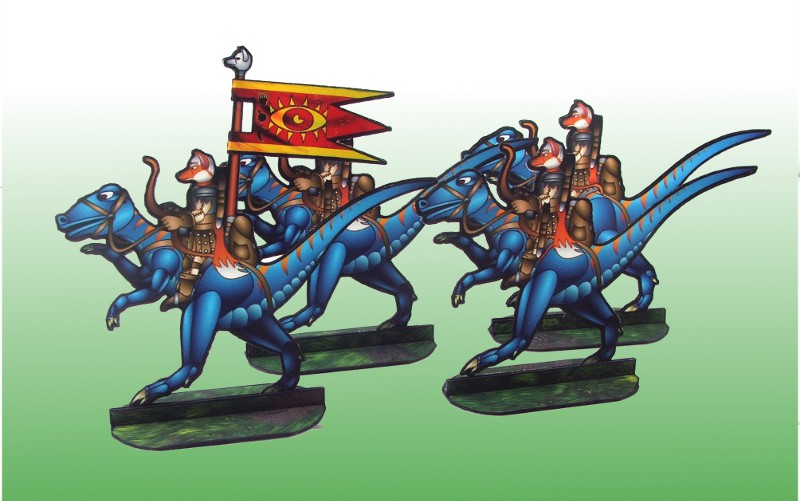
Next up was the Longbow men, they turned out looking a little robinhood-ish and I only did 3 different poses and limited the legs to left/right/center. Next was the Light infantry equipped with light chain mail and leather armour. Then I worked up some Light cavalry mounted on dinosaurs with the fox’s wielding short bows. At this point I went back and worked up standard bearers for the 4 troop types designed so far. I did a vertical and Horizontal Standard bearer for each troop type, except the cavalry which got horizontal banners only.

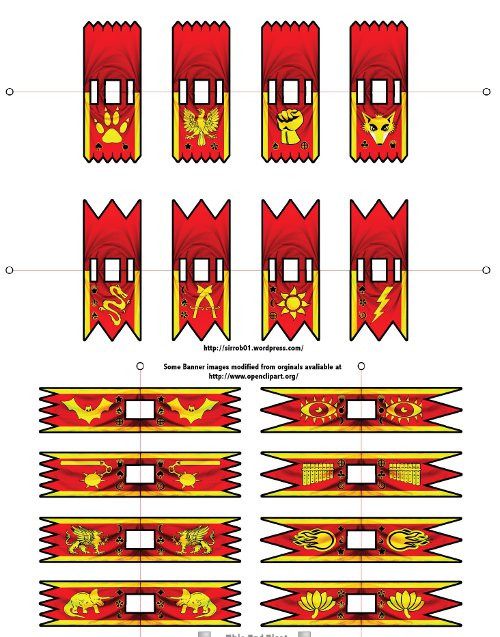
As I’d designed each of the troop types to have a unique look I decided the banners should be of a consistent design to help give the army a consistent look on the table. I used images from the open clipart library as bases for some of the banners but recoloured the images. Some designs I drew myself. I did 8 designs of each vertical and horizontal in red and gold/yellow theme:

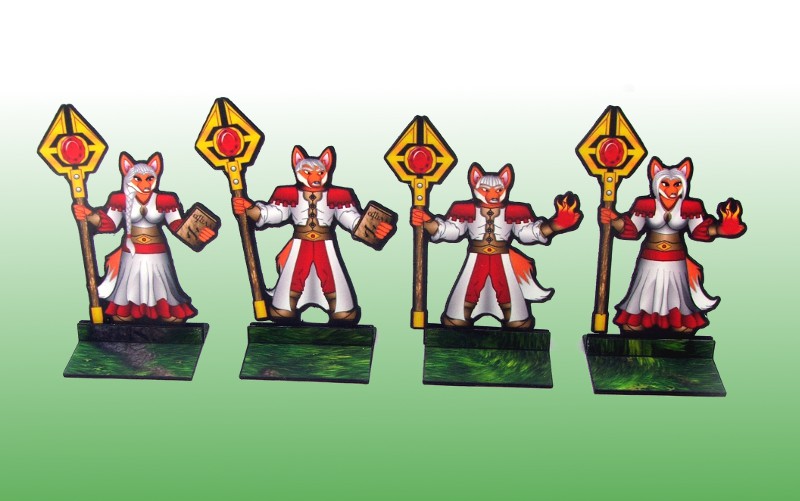
Once the banners were done, I designed up a Mage and Hero to give the army some special characters. The last troop type I worked on for the Hoard was a set of pikeman. Once the troop types were done I worked up the craftrobo cutting files and did some test builds of each of the troop types, frustratingly I seem unable to get a consistent result with my cutting files sometimes they cut very accurate and the next time not so accurate.

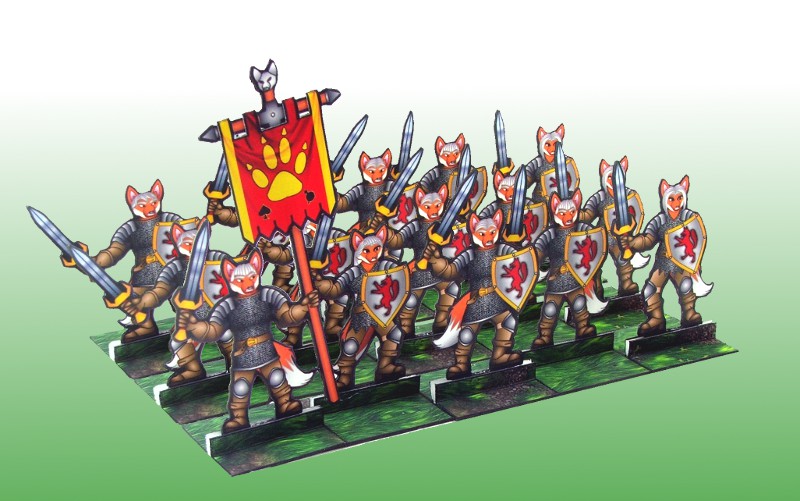
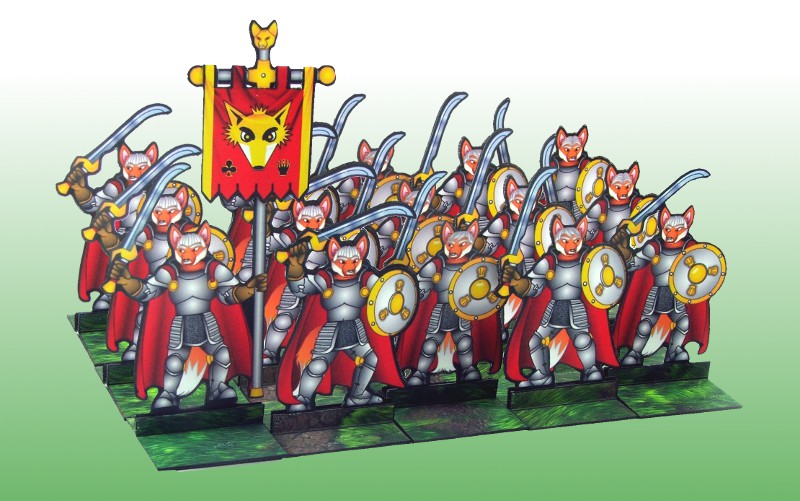
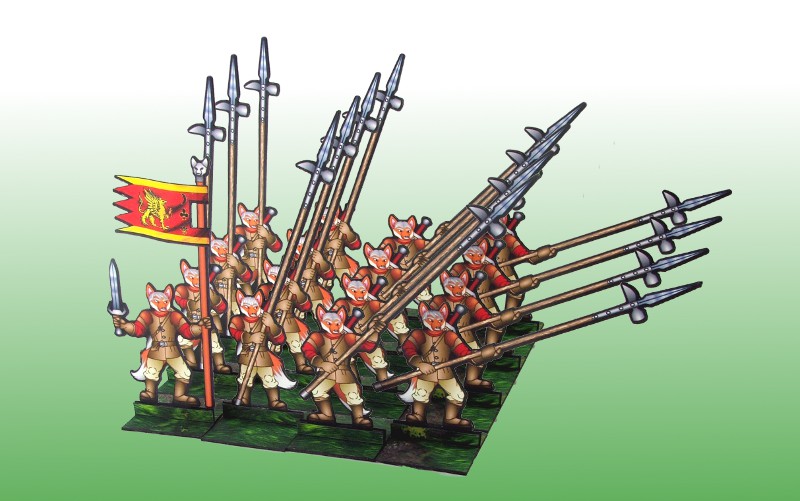
Below are the test builds of each of the troop types mounted on one monk hinterland bases:

I plan on working on the missing troop types over the next 2 months as well as doing a set in 15mm so I can use them for HOTT/For the Masses. For any who are interested the PDF’s/GSD’s are below if your looking for bases, onemonk has a great set:

Fox Sword Infantry Fox Standard Bearer
Fox Pike Infantry Fox Longbow
Fox Light Cavalry (Red) Fox Light Cavalry (Blue)
Fox Light Cavalry (BannerHolder) Fox Hero and Mage
Fox Banners

For the GSD files below you’ll need to right click save as the files and then rename the extension to GSD rather than odt

Fox Sword Fox StandardBearers
Fox Pike Fox Longbow
Fox Light Cavalry(Red) Fox Light Cavalry(Blue)
Fox Hero_Mage Fox Banners
Fox Light Cavalry(Banners)

Zip File containing all files, hosted on 4 shared so if I’ve forgotten to login in for amonth it maybe unavailable (sorry):

Fox Army Zip

Also avaliable over at One monks site in Hoard 60 – 68:

One Monk hoards

I hope you enjoy using the paper fox army. I’ll move back onto my project list now 🙂

Magnetic Corflute Lightbox (Prototype)

My old cardboard box lightbox didn’t survive the big cleanup and was looking the worse for wear. I originally made it following the directions here, although a really good a cheap idea it does have it’s draw backs;

  • Hard to store
  • The sides are very fragile and after a few replacements the tape builds up
  • If it gets damp/wet while outside the cardboard starts to disintegrate

So I had a thought to make a collapsible lightbox using magnets and corflute (the stuff house for sale signs are normally made of, plastic corrugated cardboard). It also meant I could build a slightly bigger box and have it semi damp proof and easy to store. The idea was to laminate the two pieces of cor-flute together for each side with tape and have a layer of baking paper/tissue paper between the layers. Then use magnets and nails to hold the whole thing together.

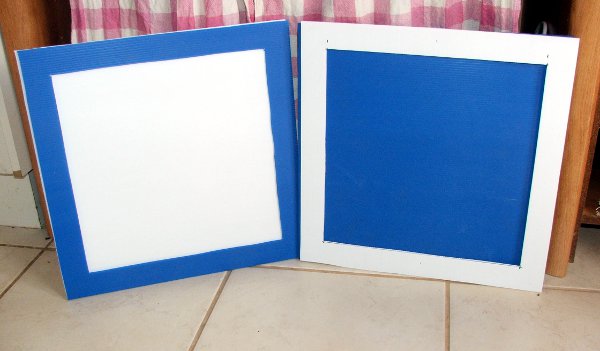
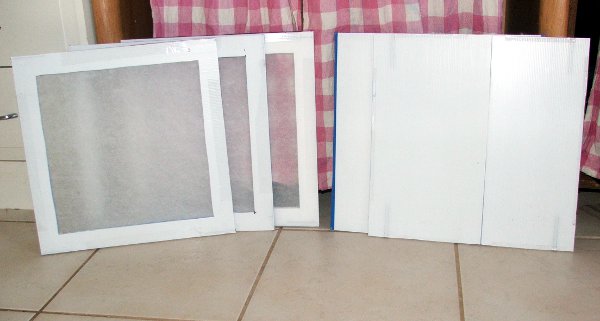
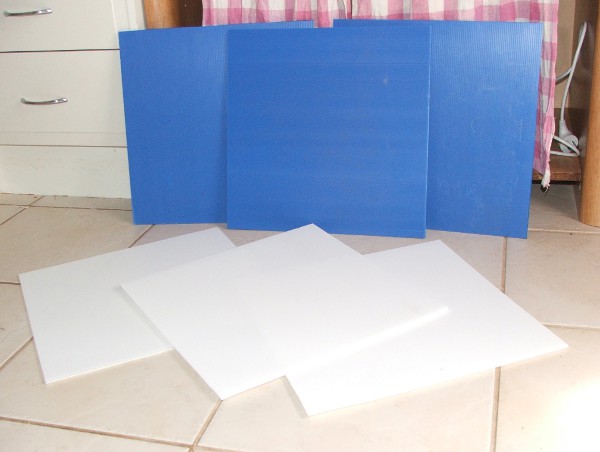
Started of with some white and blue cor-flute I had left over from another project (3mm stuff) and cut out 10 squares 15inchs x 15inchs ( I didn’t quiet have enough white and had to use two smaller pieces to cover the bottom):

After cutting out all the squares it was time to cut the middles out I left a border of 1.5inchs around the outside and then cut the middles out off 2 of the blue pieces and 4 of the white (yes oops 🙂 ).

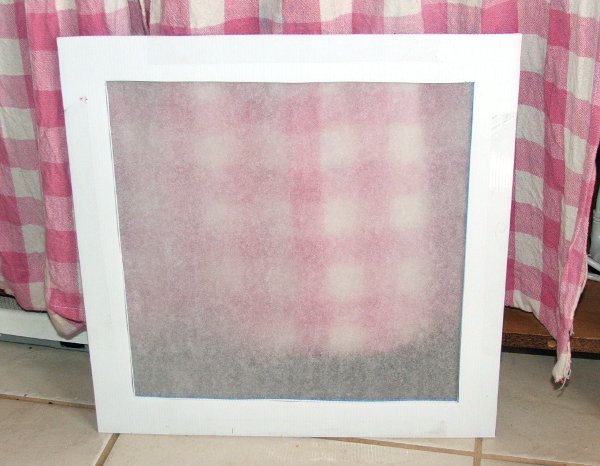
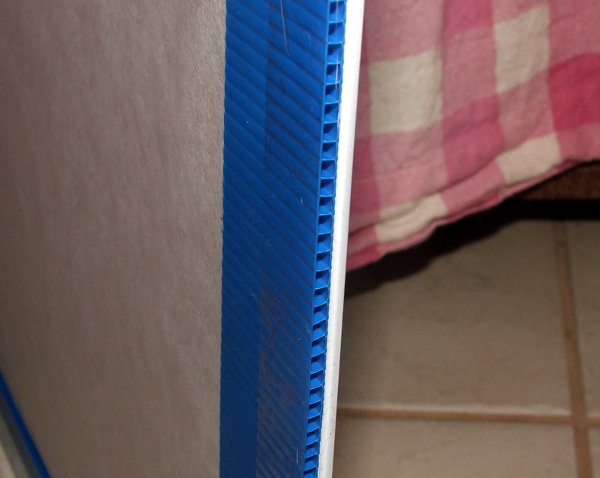
Next up was to tape a piece of baking paper across the square hole, I did a piece of tape at each corner and piece halfway along. Then a taped the white and blue pieces together by taping each of the long sides together. I oriented each piece of cor-flute so the flutes ran at 90 degrees to each other for added strength:

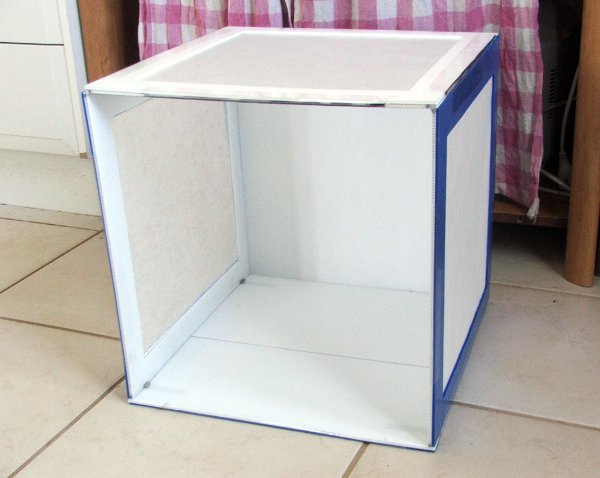
Once I had the top, back and bottom built it was time to try and fit it all together. Down 2 rows of flutes on each wall I pushed some nails (big ones), then using some magnets I had laying around I held the whole thing together:

Hmm, it worked and it wont fall apart if I bump it while putting things in and out but I definitely need some slightly stronger magnets. I’d say at a guess about twice the size or twice the strength or a little of both. It takes about 1-2mins to assemble and a little longer to pull apart, I’ll keep my eye’s open for some cheap stronger magnets and try those in the future for now I’ll call this a prototype and work on it again once I source those magnets.

Anyways I’ll go back to working on the dragonfly now ;).

Repainting the Lounge Room

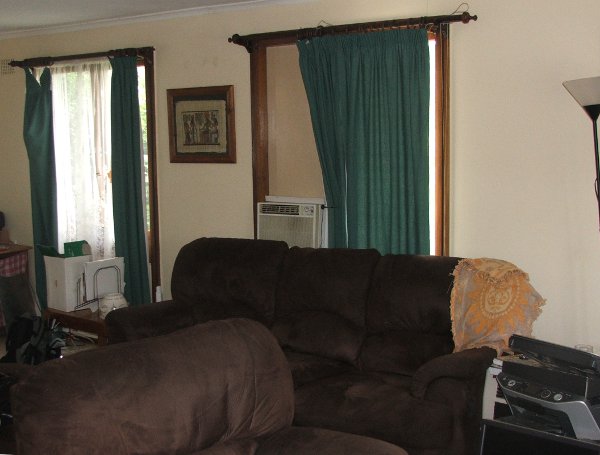
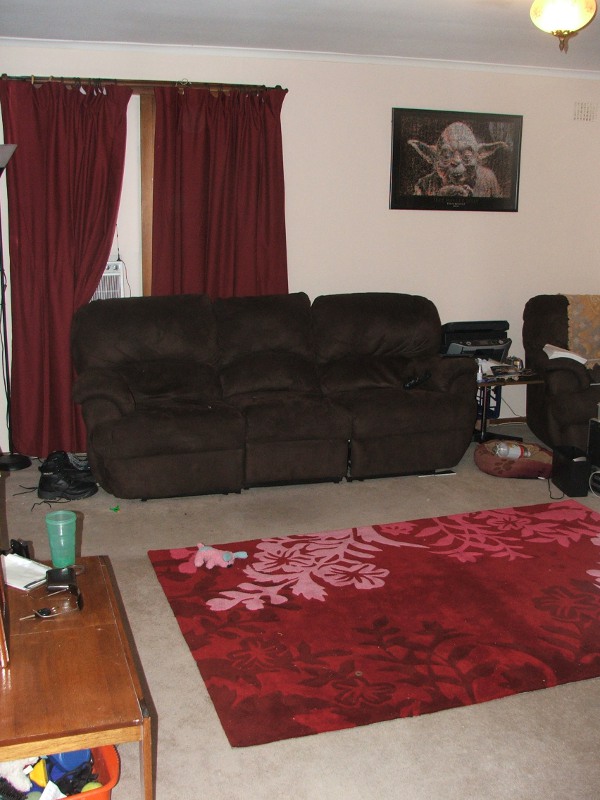
This was an unexpected project that pretty much cropped up as we had got rid of the nasty wood paneling but it really bought the mould yellow walls and green curtains into stark focus, not much we could do about the heavily stained carpet. I didn’t get a true before photo but below is a photo of what we started with:

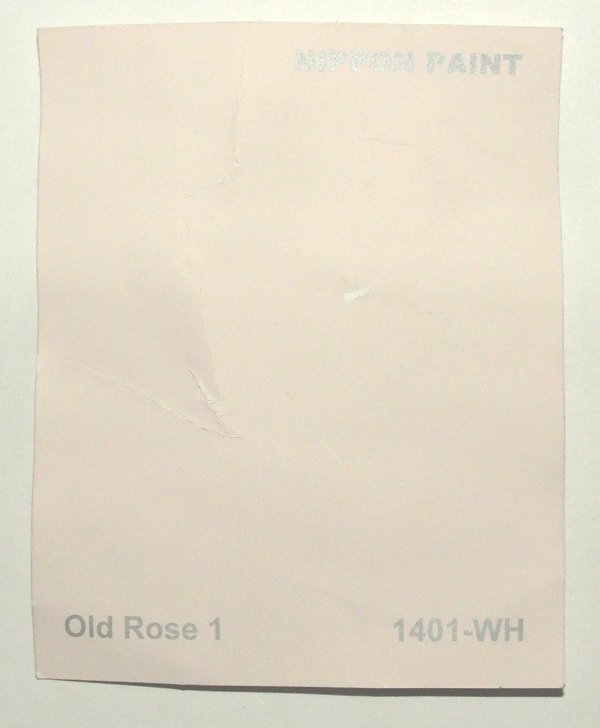
As is always the case when repainting, first stop was the hardware shop and the mandatory 2 hour spousal debate about which shade of colour to get and just when you think you both have something you can live with of course a totally different colour catches your eye. In the end we settled on something called Dusky Rose by nippon paints which we then had mixed up in 4 liters of British paints flat base. Below is a picture of the colour card:

I’d recommend to anyone thinking of painting to put the dog outside we ended up with pink paw prints all across the nice chocolate brown lounge. Fortunately as the paint was water based a quick wipe with a damp cloth had the paint removed, although we probably could have said it was a new trendy pattern.

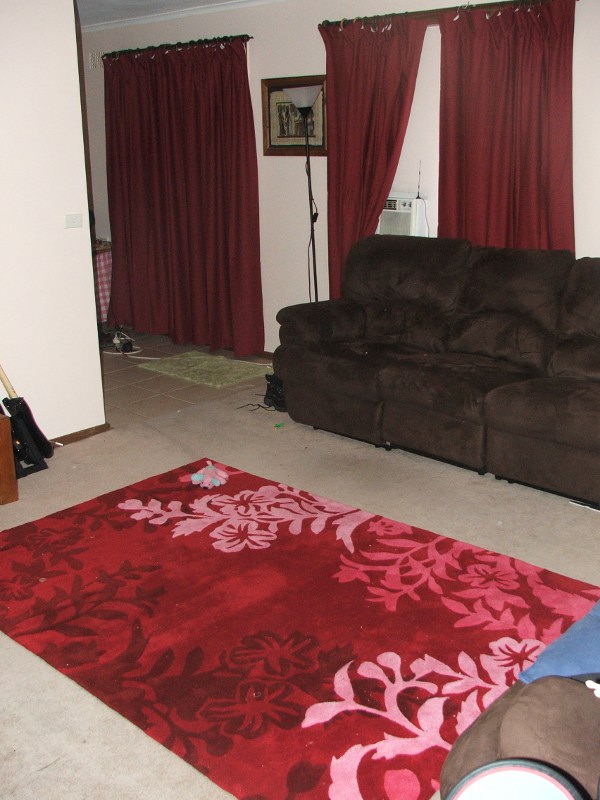
While we waited for the paint to dry we headed to spotlight to get some new curtains. We didn’t really want a christmas theme in the lounge room of green curtains with light pink walls. We found some very nice deep red/claret curtains in spotlight that where full blockout and quiet heavy. We bought three sets to replace the 3 green sets in the lounge room. Although with the both of us knowing about as much about curtains as we do about brain surgery we did forget to buy the string you need to thread through the top that makes them pencil up, but we hung them up anyway and they look much better than green.

The last little job was to hang two new lights on the side wall were the old fake gold ones had been we went with simple round lights. Although neither of us is to hot on the chrome. They were cheap and as the wall they hang on is probably going to be removed in the future when we re-do the kitchen they will do the job for now and certainly look better than the old half broken light fixtures.

Here’s a couple of photo’s of the whole room:

Although this wasn’t an expected project it’s certainly helped improve the look of the lounge room and it feels more like our house (the lounge area anyway) now rather than somewhere we just happen to be living.

I’ll be moving back to one of the three main pending projects now and having a think about what I’ll add as a fourth.

Lounge Room Wall Repair

The lounge room wall in our house has always looked like it was trapped in the 1970’s . My parents dropped down for visit and to help with one of the many house repairs needed. As this is one of the cheaper repairs required on the house we decided to rip into it. I’d investigated under the fake wood sheeting previously and the plasterboard underneath was heavily damaged and covered in (if you can believe it) a wallpaper even uglier than the fake wood. Additionally we wanted to remove a door that was present between the lounge room and the hallway as it was damaged and we rarely use it.

Day One

We started off by ripping the fake timber pattern of the wall, this pretty much fell off and we were left with an ugly wallpapered wall. Next step was to start removing the old plaster board sheeting with the lovely wallpaper stuck to it. This was a fairly easy task with two pry bars (although three dead desiccated mice did fall on us), we also removed the door jam from the wall side of the door. This was pretty tough as the builder had used very heavy duty nails (10cm) through the jam into the house frame which is some form of Australian hardwood. After much prying with the old blacksnake(6foot crowbar) it came free:

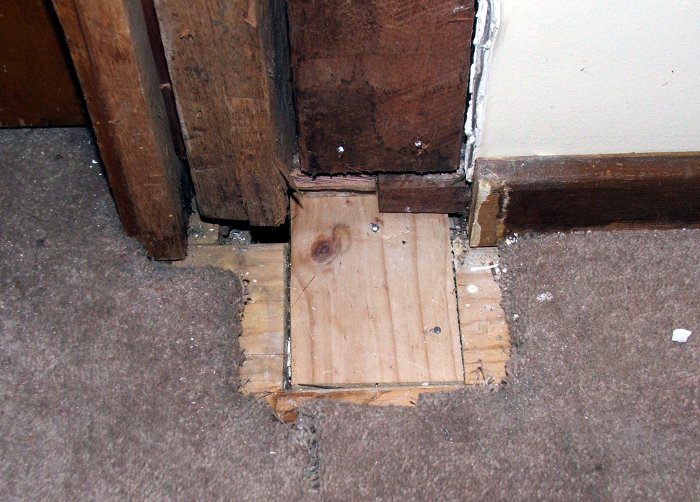
As the doorway was slightly narrower than the hall we had to relocate the uprights that the door Jam on both sides were attached to back in line with the wall. Oddly enough the support on the hinge side of the door that the door jam had been fixed to was actually sitting on nothing…no floor boards, no joist, no bearer. Best guess we have is that the upper massive nails were holding it in place. This of course meant we had to fill a hole in the floor with a small piece of wood. Talk about building to a price :). Unfortunately I didn’t get a before photo but here’s a shot after we had patched it up and set the up right back inline with the wall(it was a right pain fitting the patch in):

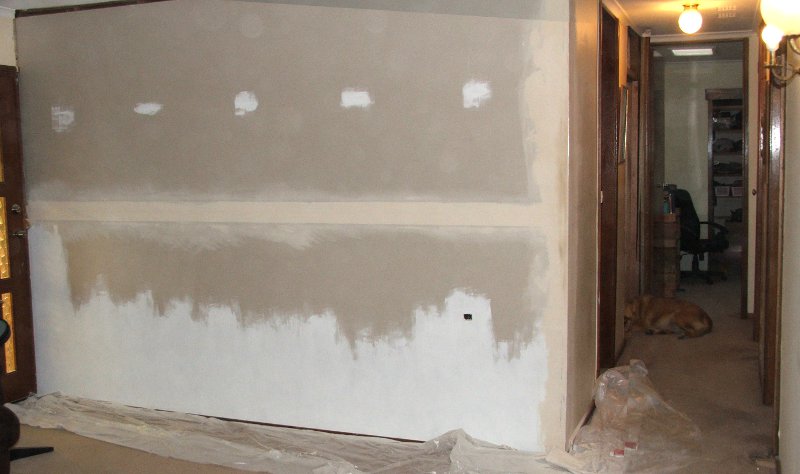
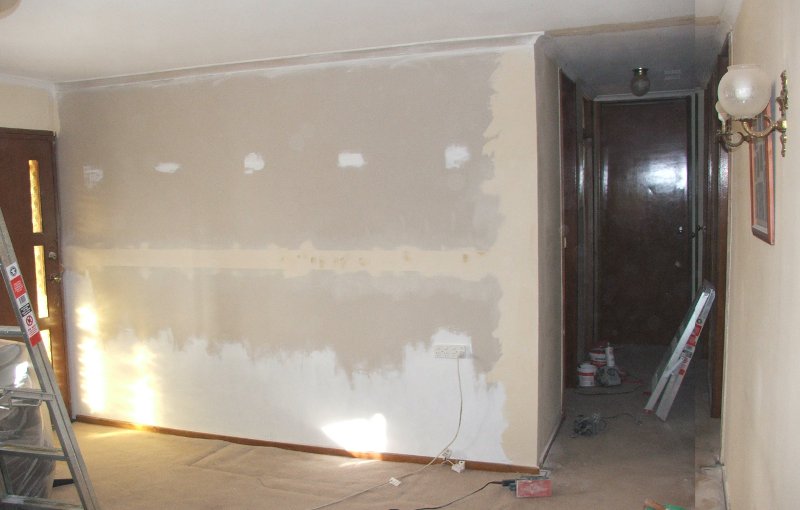
After we had the above framing elements all adjusted we put up the new plasterboard on the wall using standard plasterboard nails and glue. Our house has about 2.5m ceilings so when we fitted the two 1.2m wide sheets we had to locate them fairly accurately to ensure we didn’t end up with a gap at the top or the bottom. It would seem metric modern plasterboard really isn’t designed for old houses with high ceilings. We successfully got the top and bottom sheets up and began the plastering, we also painted the lower edge were the skirting go’s to save on cutting in later on when painting. This was pretty much the end of day one’s effort (the below photo is a composite of two photo’s):

Day Two

The look of the wall didn’t change to much during day two. We started of in the morning by doing some sanding of the plaster we finished up last night and putting down the first finish coat of fine plaster in a few places. The big job or fiddly job for the day was trying to fill the gap in the ceiling and match the cornice up from lounge room to hall.

The gap in the ceiling was a problem as the hall ceiling is slightly higher than the lounge room ceiling plus we had a support beam at about the same level as the lounge room ceiling. We ended filling the gap between the support beam and the lounge ceiling with a small piece of plasterboard. Then sanded the support beam surface a little to smooth of the rough edges, finally we skimmed a layer of plaster across the whole lot. We then just made a small plaster step up from the support beam to the hall ceiling and plastered it. The end result looked okay and should look fine once all the sanding is done.

The above problem of course meant the cornice also didn’t line up, so we had to try and custom fit two small pieces of cornice between the existing/new cornice in the lounge room and the old cornice in the hall. This required a lot of fiddling and use of plaster to shape and streamline the pieces together. The result looked okay although a fair amount of sanding and shaping will need to be done tomorrow.

The remains of the day were spent sanding and plastering so as we could hopefully have the wall ready for painting, by the end of tomorrow. We also adjusted the laundry door so it opens and closes easier, although not really part of this project we were waiting for plaster to dry. Below is a picture of what the wall and door (or not door?) looks like at the end of day two:

Day Three

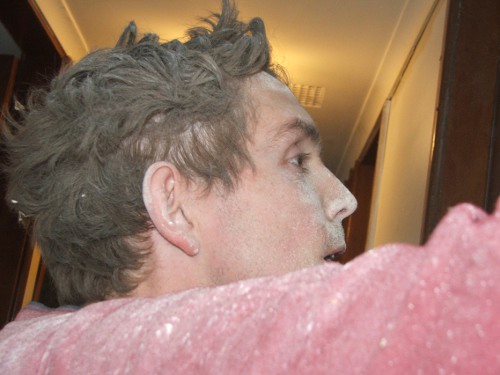
Very little building work today, other than tiding up some skirting board and door architrave. We spent most of the day sanding down plaster and smoothing it out ready for a coat of paint. The house of course ended up in a nice fine layer of white powdered dust from all the sanding as did I :):

Not all the painting was finished but the little bits left can be done later on. A fairly tough 3 days and I’m pretty tired, but I’m very happy with the result and the way it opens the room up, you can see the result in the below picture:

Another project down and time to move along to one of the others 🙂

Dragonfly-Wargamming Model(Design:Part 1)

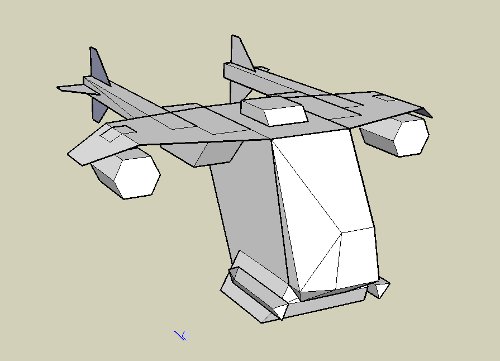
I finished up stage one of the design of my flying wargamming model. So I’ve decided to do a 3 part post series rather than one big post once it’s finished. So this one will cover the evolution of the sketchup design.

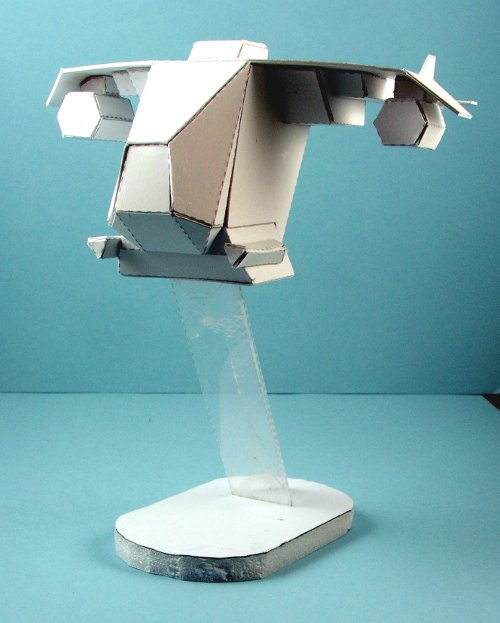
The idea behind the design is that it’s a single seat attack craft VTOL capable, while packing a significant punch to be a credible threat to more heavily armored  tanks and vehicles.  Two light weapon mounts  are present on the lower sides of the model, I’ll texture these as MG ‘s and possibly small lasers as an alternate. Under each wing are some small 5-6 shot rocket launches which can be filled with anti-vechile rounds.

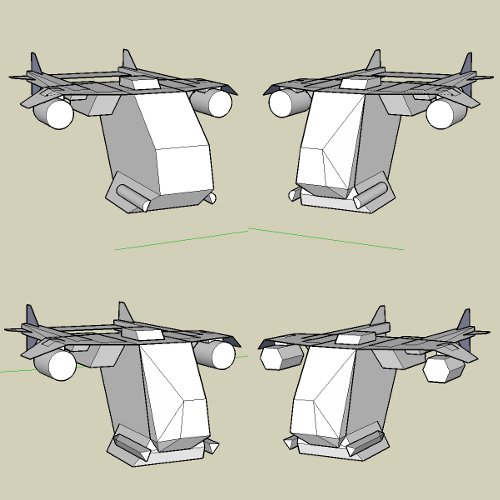
The design went through 4 main phases:

  1. The first was very blocky, although easy to build other than launcher pods
  2. The second provided some shape to the front cockpit so as to appear more glass like,
  3. The third improved the lower weapon design so they are triangular and easier to build,
  4. The fourth and last lengthed the wings slightly and turned the round missile racks to hexagons for simplified building.

The below photo shows the four sketchup models, Top left=One, Top Right=Two, Bottom Left=Three and Bottom Right=Four

I did three test builds in paper to help refine the design and developed the clear mounting post from transparency to give the impression of flight. Below is a picture of the final design although I did move some of the fold tabs around to simplify building in the future, the builds pretty rough but I was in a little bit of a hurry :):

Next step is to move onto texturing which I’ll detail in part2

Mini Caramel Cups (Both versions)

Busy weekend for me with a friends birthday and Australia day coming up. This is a recipe I put together/modified last year, it’s a bit fiddly (the gluten free version is more so) to make but always a hit when served. Both the gluten free and regular recipe are below but the photo’s are from my latest batch of gluten free one’s. Feel free to sub my Potato and Rice flour mix for an off the shelf SF raising and plain gluten free flour. The gluten free version of the recipe below was assembled for a friend who’s also corn intolerant.

Ingredients (makes 24-26)

Base

Regular Gluten Free
85grams Butter 85grams Butter
50grams Self raising flour 60grams Rice flour
50grams Plain flour 70grams Potato flour
115grams Brown sugar 140grams Brown sugar
55grams Desiccated shredded coconut 1/2 teaspoon Bicarb Soda
1/8 teaspoon Guar gum (optional)
  1. Preheat Oven to 180C
  2. Melt Butter in large mixing bowl in microwave

  3. Add the Brown sugar to the butter and mix in then add the Coconut and mix in.
  4. Add both plain and self raising flour (or Rice and Potatoe Flour with guar gum mixed through) and mix in well (ensure no lumps). The mix will be dryish but should stick together.
  5. Loosely spoon the above mix into the 24 depressions in a Mini Muffin Tin (grease tin if not non-stick or silicon) each depression should be filled neatly to the top.
  6. Grab something with a flat end which is round and approximately 25 mm across (potatoe peeler end or wooden spoon) and push this into the middle of each of the mini muffin pan depressions, rock the object as you push down to help compact the sides. The mix should compact on the bottom and push into the sides firmly but the top edge will be ragged and untidy. Using your fingers level of the mixture with the top of the mini muffin pan (this is fiddly and time consuming) to make a neat edge. If you can see the bottom of the tin through the bottom of any cup add a little mix to the bottom and compact softly. Aim for a cup thats 1.5 to 2mm thick.
  7. Place the Cups into the Oven for approximately 5mins and watch them. They will expand and slowly fill the muffin depression. When you see this grab them out of the oven and push the sides and base back down using the wrong end of a butter knife or your wooden tool, so they are back into shape. Place back into the oven and watch again repeat the above if they deform, they will take approximatly 15-20mins to cook. Keep this up until the shells turn a golden brown (The gluten free ones don’t brown very much) then remove from oven and using your knife end or wooden tool push shells back into shape for the last time. Leave to cool for at least 20mins.
  8. Carefully turn the muffin pan upside down and bang (Wooden spoon) or pop/lift (if using a silicon tray) the shells out of the muffin pan and leave upside down on another tray to cool fully. As they cool the cups will harden. If your making the gluten free one’s do not bang or jar the shells they are a very fragile it’s best to make them in silicon bakeware and simply lift them out when they are cool or fill them with caramel and then lift them out.

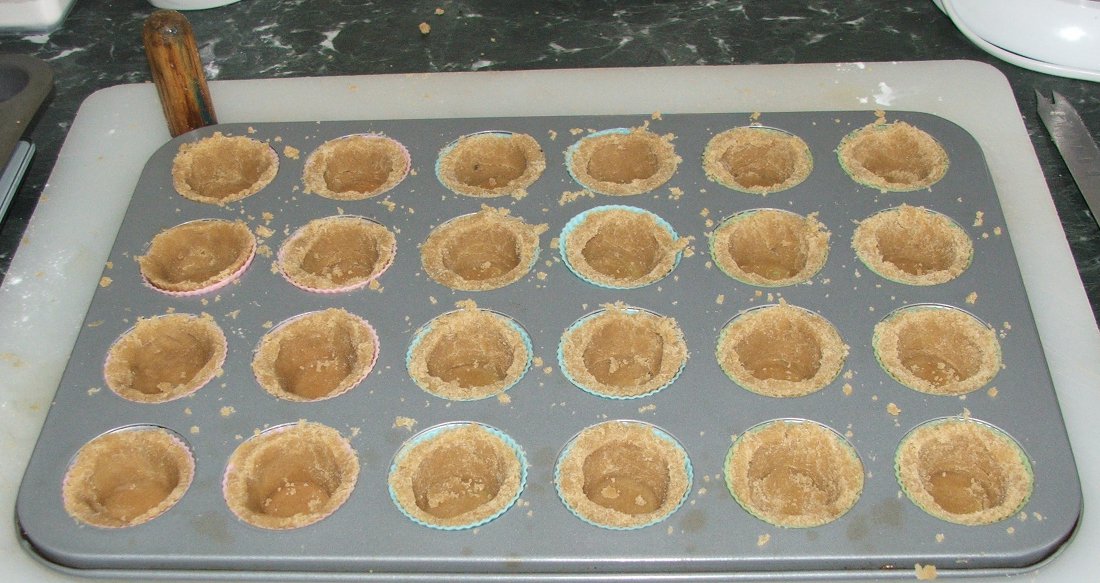
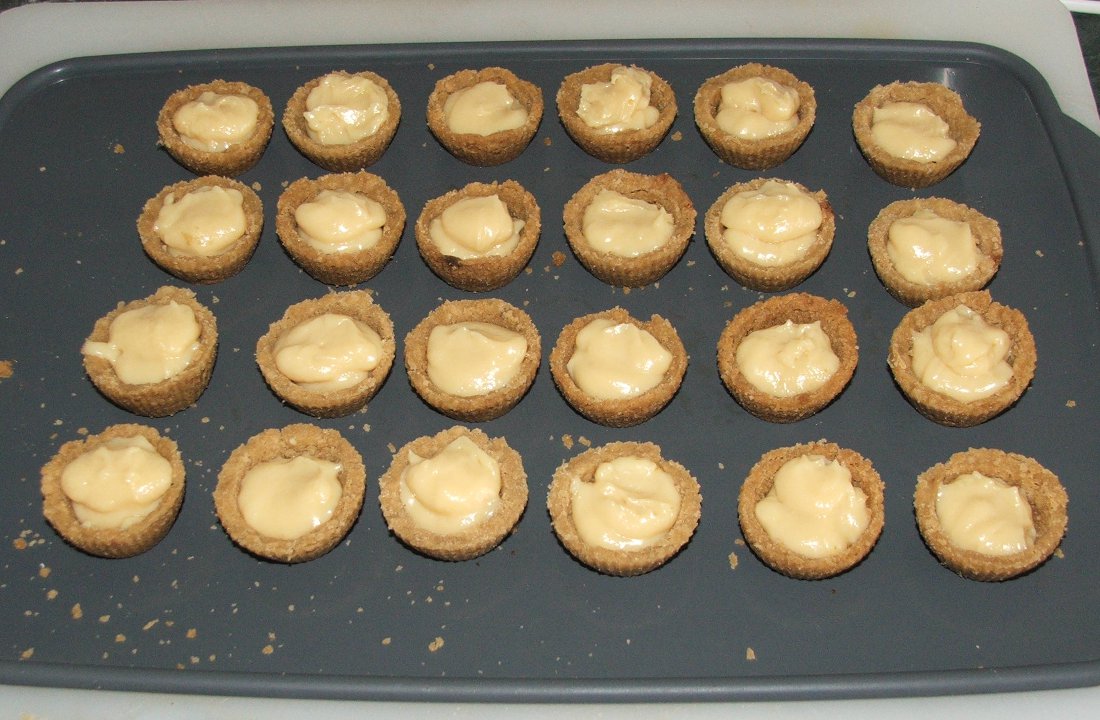
In the below picture you can see the mixture has been compacted in and is ready to go in the oven, the object in the top left of the picture is what I use to compact the mixture into the muffin pan, a short piece of 25mm dowl.

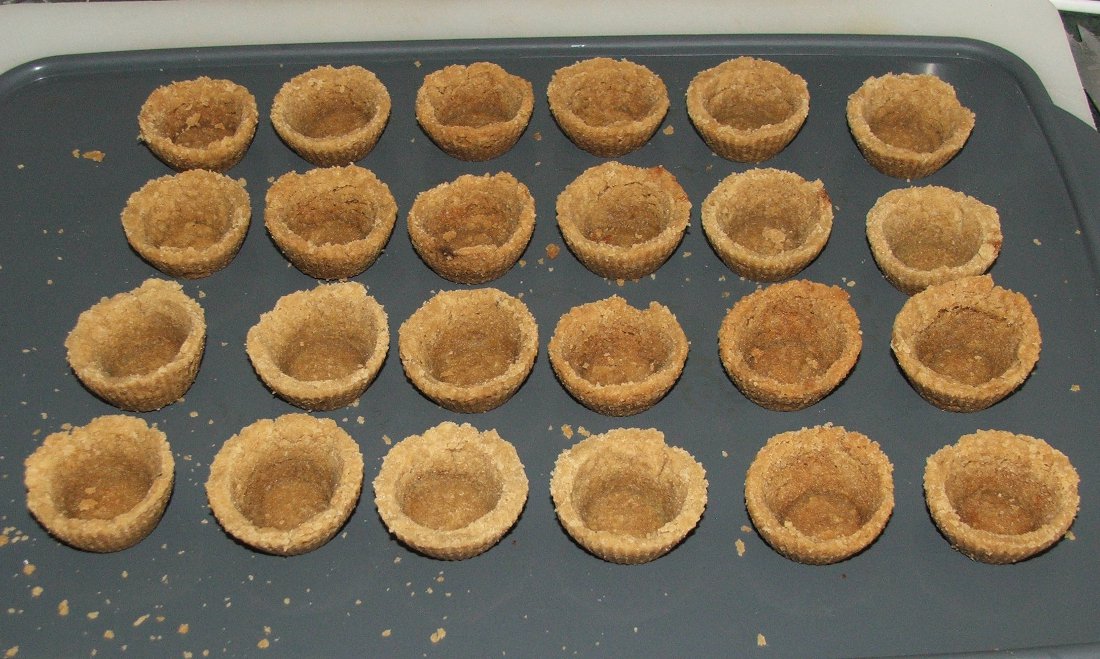
Fresh out of the oven and finishing off their cooling

Filling (Same for both)

Regular/Gluten Free
30grams Butter
40gramsGolden syrup

(ensure it doesn’t use any nasty gluten thickeners if it does sub in 30grams brown sugar)

1 tablespoon Brown sugar
2 teaspoons Vanilla Essence
395g Sweetened Condensed Milk ( 1 Tin

I make my caramel in the microwave in a large rice cooker but you could use a microwave safe bowl with high sides. A word of warning caramel gets very hot (hotter than boiling water 150-200C) and can easily cause 2nd degree burns if you drop any on yourself while cooking it or spooning it into the cups. I have a nice 20 cent sized burn scar on my left hand where I got careless one day and some dripped on me. Don’t let anyone (or pet) lick the bowl until it’s well cooled.

  1. Place Butter into your microwave safe bowl

  2. Melt the butter in the container then add Golden Syrup/Vanilla Essence and Brown Sugar, Stir in well and then microwave on high for 30secs and re-stir, the Syrup should have gone more fluid. (My microwave is small and low powered 800 watt max so adjust times or power settings as needed)

  3. Add the can of sweetened condensed milk and mix in well.
  4. Warning with the following steps you must watch when microwaving and if you see the mix boiling over stop microwave immediately and stir the mixture. You’ll see it coming up the sides of the bowl.

  5. Microwave mix on high for 1 min remove and stir. Microwave mix on high for 1 min remove and stir. Microwave mix on high for 1 min remove and stir. Microwave mix on high for 1 min remove and stir.
  6. Microwave mix on high for 30secs remove and stir. Microwave mix on high for 30secs remove and stir. Microwave mix on high for 30secs remove and stir.
  7. After the above it should be nearly thick enough if not microwave for another min and stir repeat until it thickens. The caramel when at the right stage will be just a little runnier than whipped cream. When you stir the mix it will take 15-20 secs to settle back to a level surface. You can’t over thicken the caramel but if it’s to runny the caramel will make a mess when people eat them.
  8. Once your happy with the consistency of the caramel grab your tray with your 22-26 cups on it and flip the cups up the correct way.
  9. Using a large teaspoon/small desert spoon, spoon the caramel into the cups each cup will take 1-2 spoonfuls. I usually fill each cup to almost full then come back and top them up with any left over caramel. The caramel will hopefully end up with a peak in the middle just above the level of the cup wall.
  10. Leave the cups with caramel in them to cool fully. 3-4 hours in the fridge works best, but if your pushed for time 1 hour int he fridge works.

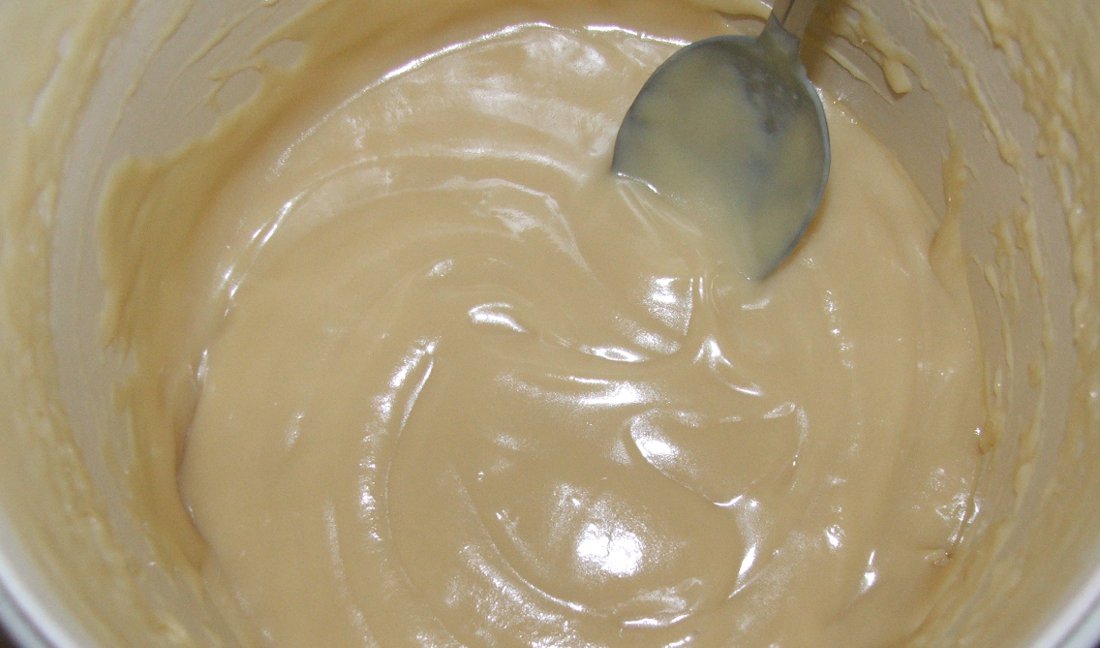
Below is a picture of my Caramel after it’s thickened, you can clearly see the stirring marks in the surface.

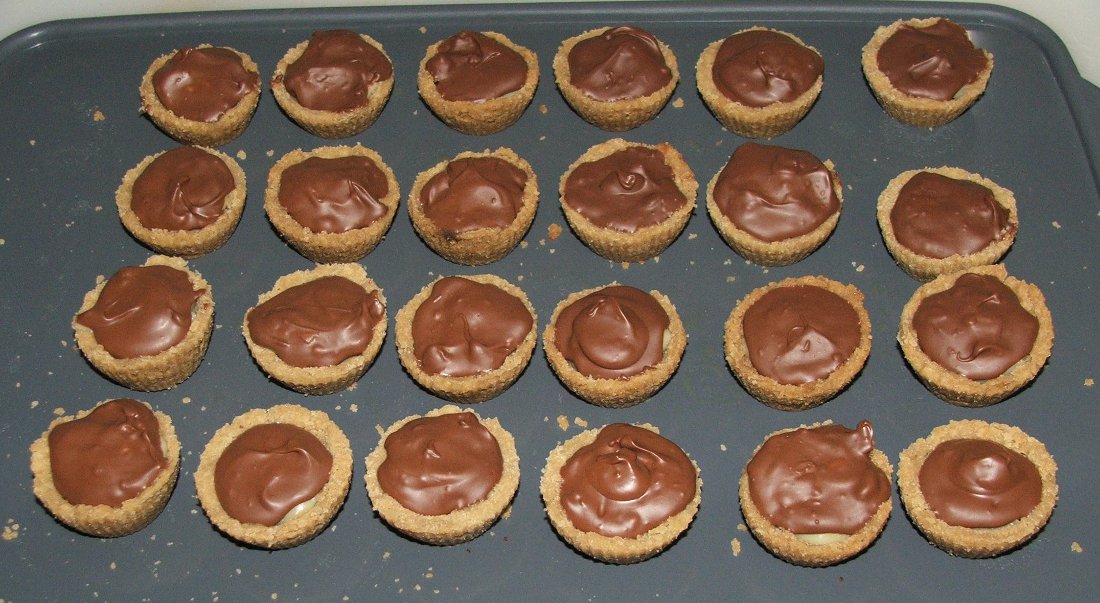
My cups filled with caramel and ready for the fridge, prior to them being capped with chocolate and/or coconut

Topping (Same for both)

Regular/Gluten Free
75grams Milk cooking/normal chocolate
75grams Dark cooking/normal chocolate
Desiccated Coconut to Sprinkle (optional)

For the gluten free ones you’ll have to locate gluten free chocolate (not to hard). I’ve topped with cooking chocolate and regular chocolate. If you use regular chocolate melt it more carefully as it burns easier and it’ll take longer to re-set.

  1. Melt the Dark or Milk chocolate. I do this in the microwave in a small bowl with about 30grams of the chocolate each time 30-40 secs on high is all that’s needed. It’s better to under melt the chocolate, stir and then do another 5 seconds than over melt and burn the chocolate.

  2. Using a Teaspoon spread the dark/milk chocolate over the top of one of the cups so the caramel is completely covered. Then sprinkle the top with desiccated coconut (if wanted). Move to the next cup and repeat Once you have done 12 with dark/milk chocolate repeat for the other 12 with milk/dark chocolate. Or if you prefer do all the cups with one type of chocolate
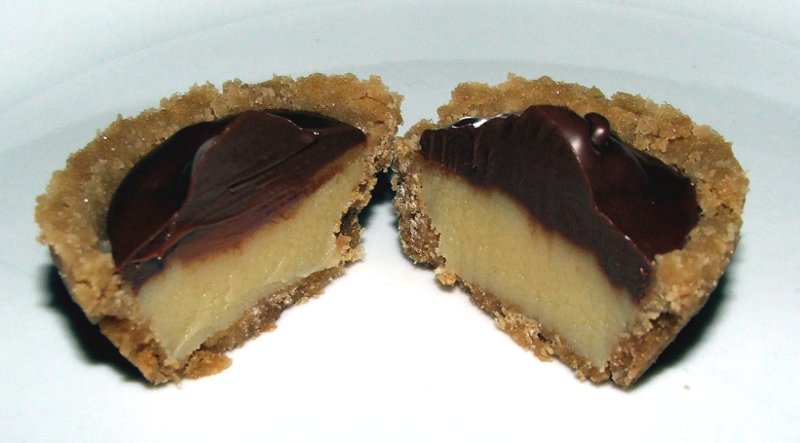
  3. put them back into the fridge until the chocolate has set. Once set the caramel cups can be eaten straight away, refrigerated and saved for later or frozen for a short time and used later on.

I need to make these quick

Okay sometimes you just don’t have the time to make the cups if this is the case grab a shallow rectangular tin approximately 25cmx15cmx3cm (line with baking paper for quick removal). Push the base into the bottom of the pan extending it a little up the sides and bake, then spread the caramel on top allow to cool for bit then spread the chocolate on top, leave to cool in fridge, lift it out of the tin and cut into squares.

Enjoy 🙂


Project Status


WWII Project First Release

80%


B-tech Buildings Five

20%


Design Victorian era City

15%


Something Different

5%


Enter your email address to follow this blog and receive notifications of new posts by email.

Join 110 other subscribers

Content Released Under

Creative Commons License
This work is licensed under a Creative Commons Attribution-NonCommercial 3.0 Unported License.
Please Attribute to Sirrob01 with a link back to my blog